
By Syrulwa Somah, PhD.
The Perspective
Atlanta, Georgia
June 28, 2004
Editor’s Note: Dr. Syrulwa Somah, Executive Director of the Liberian History, Education & Development, Inc. (LIHEDE), and an Associate Professor of Occupational Safety and Health at NC A&T State University, was the Keynote Speaker at Cuttington University College student general assembly. The Meeting was held at the Old Road Campus of the College. Below is the full text of Dr. Somah's address:
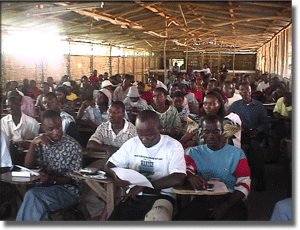 |
Cuttington's Students |
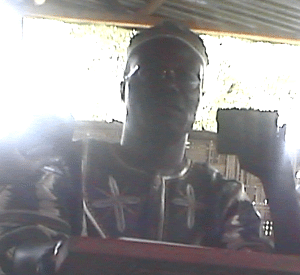 |
Dr. Syrulwa Somah |
Dr. Henrique F. Tokpa, President, Cuttington University College, Dr. Saaim Naame, Vice President for Academic Affairs, members of the faculty, students, members of the Press Union of Liberia, distinguished quests, madames et messieurs, my fellow Liberians, ladies and gentlemen:
My brothers and sisters, it is good to be with you this afternoon at this student assembly, especially for allowing me to speak to you on a few things that really “catch my heart.” It has been 15 to 24 or more years since I visited Liberia or some of you saw me. But God has a reason for everything. Many things have happened in our country and in our lives since. But thank God we are still alive to come together as we are doing here today, to reflect some thoughts on our common problems as a people. I am happy to be home, and I am happy to see all of you. I know that God has a purpose for each of us in this life; otherwise, we wouldn’t be here today. I believe God spared our lives so we can rebuild our homes, our families, our towns, our villages, our schools, our cities, and our country. But it will not be easy. The challenge is great. But if our God was able to lead the children of Israel to the Promised Land from captivity in Egypt, He is able to unite all Liberians to rebuild their country and to live in peace as brothers and sisters.
God didn’t come down from heaven to lead the children of Israel to the Promised Land. Instead He counted on the children of Israel, the men, women, and children of the Hebrew people, led first by Moses, and then by Joshua, to follow His direction to the Promised Land. Today, in Liberia, we need good leaders such as Moses and Joshua to lead us on the path of unity, peace, and reconciliation so we can together rebuild our country. We ought to be tired of being slaves in our own country. It is time that we think long and hard about the kind of life we want for our children and ourselves tomorrow. We have to be firm in our desire to see total peace and stability in Liberia, otherwise we will continue to guess about the kind of life we want to live if we do not work together and choose the best leaders for us.
In the task of choosing our leaders, we must be mindful in the description of who we choose. That is to say, what kind of leader we really want? I know we all want good leaders, but who do we consider good leaders? What characteristics of a good leader do we want? Well, you know for the children of Israel, not only did they produce their own leader, but their leaders were their servants and not their masters. Even when God referred to Moses as a servant of the people, Moses became humbled and said, “O my Lord, I am not eloquent, neither before nor since you have spoken to your servant …” (Ex. 4:10).
You will note that Moses considered himself as God’s servant, not God’s leader of the Hebrews. It is stated that more than thirty times throughout the Bible, Moses is referenced as God’s servant, or “the servant of the Lord.” What is important in this description is that all great biblical leaders have this title from the Almighty God: Joshua, Samuel, David, Caleb, Job, and even Israel is called as such. This is also one of the names and titles given to the coming Messiah in which Jesus describes Himself as a servant of the people (Mt. 12:18; cf. Isa. 42:1)
Brothers and sisters, in our modern society, the word servant is not a very pleasing word to the ears. Many of us hold the word or title of servant generally in very low esteem. We think if you are servant of the people than you don’t worth a salt. But that is not what the word “servant” means before God. It means you are your brother’s keeper. It means you will not give your brother or sister something that you wouldn’t use yourself. It means you are willing to sacrifice your own happiness for the happiness of your friends and relatives, and the good of the country. If you are such a person, you are not only a good servant of the people, but also a good leader of the people.
Today in our nation, there is a general misunderstanding about being servants of the Liberian people. Every person in authority in Liberian thinks he or she is master and not servant of the people. But every leader is a servant of the people because without the people one cannot be a leader. A leader is chosen by the people so he or she could serve their best interest and not to work against their interest. Liberia is undergoing very troubling times and we need a servant of the people to lead us in rebuilding our lives and our country.
Like the Hebrews, we in Liberian must know that we are blessed. Our nation is blessed with the earth’s finest climate and fertile soil for agricultural enterprise, for growing bananas, rice, cassava, Malaguatta pepper, mushroom, coffee, kola, mango, okra, palm oil, papaya, rubber, and much more. Iron ore tops the list of Liberia’s mineral wealth, making this country one of the leading iron exporters in the world of Barite, cyanite, diamonds, gold, graphite, and manganese. These are key avenues and opportunities for wealth generation in Liberia, which could be used to the benefits of all Liberians.
Liberia is also endowed with abundant natural resources, with forests covering nearly 14 million acres, including 230 species of useable timber such as Mahogany, Walnut, and Makere; while wildlife such as elephants, water buffalo, lions, leopards, chimpanzees, and eagles are plentiful in Liberia. But none of these natural resources has the value of a grain of sand, because of our greed and our collective failure in developing our human capital, and our dependency on foreign theories. Had our national leadership promoted our heritage and instituted good governance, as opposed to power being wielded by a few and knowledge confined to a few, our nation would have had the hand and the brain behind it to make great inroads in the socio-economic developments of our country. But here we are rich but poor at the same time.
Unlike the Hebrews who relied on their customs and traditions to develop the Promised Land, the westernization of Liberia swept our feet from beneath us only to have our technological achievements deliberately trivialized. Day-in and day-out many Liberians and their foreign friends deliver our natural resources to foreign nations to meet their development aspirations while Liberians die from hunger, malnutrition, and other calamities.
In essence, the finest climate means nothing; the fattest soil has no value; the richest mines of Liberian mountains are worthless; the safety and cleanest harbors that border our nation are of no value when we are ignorant of our own origins and capabilities. As we have seen, Liberia, with 43,000 square miles of good soil naturally blessed by the tropical sun, with millions of beautiful people, is without the resources to feed her people, clothe her people, provide protection, and send in experts to run her government and write books on her history.
Liberia is like a big balloon that moves with every touch and every breeze. We hold our presidential debates next door in places we are rejected as a “step child,” just to let “big mom” know we are children on our best behavior. We crawl our knees to “big mom” so she can select our biblical Adam for us. We just don’t seem to know who we are. We are never confident in who we are and what we are doing unless people from the outside tell us what is good or what is not good for us. We are like that stepchild always seeking attention.
In the book of Genesis 1:1-2, we a see a compelling story again that can help us with the concept of self-consciousness. For some unknown events the earth became formless as darkness covered its surface after God’s first attempt at creation. For some strange events, the earth became dark and formless which surprised God but He was not discouraged. He made His second attempt at creation for six to seven days and saw that everything was good. However, God had another problem at hand. He wanted someone to name these things He had created. Therefore, God decided to make an Adam to name all of the animals, trees, rivers, birds, reptiles, and creatures that fly, crawl, swim, and run. So God created Adam and he began to name God’s creatures. “This is a fish, this is snake, this is a bitter ball, this is a bird” and so forth. But we are not Adam and we are not in the Garden of Eden. We live in Liberia and we are Liberians. We cannot create a Liberian Adam, and we do not need a Liberian Adam. We need a good leader: A leader who will respect us and work hard to improve our living conditions.
In other words, in the coming elections in 2005, we need to elect the person who like Adam, can name those things that are dearest to our hearts and our nation. We need to select a leader who will take our country back from the hands of those people who can’t stop behaving like children. To steal our money, they bring war to our country, they destroy our country, and then they laugh at us. To confuse us, they totally devoid national education of indigenous culture for books like Don and Peggy, Snow White, at the elementary, to Mark Twain's Huckleberry Finn (most famous was Tom Sawyer); Romeo and Juliet and Chaucer's Canterbury Tales; Rip Van Winkle, King Arthur's Round Table and Jonathan Swift on the national level.
We barely read about any tribal hero, folktales and legends of our culture. Beowulf and Hercules were our heroes and stories about the Trojan War saturated our thinking. Children learned more about the Presidents of United States, capital cities, social studies and languages of Western countries than their own country. These western stories though compelling but are irrelevant to the Liberian culture and society. And it seems to me that our present predicament lies in the fact that we have proven to be totally unprepared to accept and implement a leadership and education system based on our own design. We have failed in so many respects to reclaim our status as a nation and people, to worship the God of our forefathers, to revere our ancestors, and to educate our nation's leaders so as to assure their greatness. We have miserably failed our people and ourselves because we are still confusing "grape vines with thorn bushes, or figs with thistles."
As Liberians, we must try to take our rightful place in the community of the world. In time, the God of our forefathers and foremothers would reveal the true “Liberian Nehemiah” to build our wall in 52 days. But we must be accountable just as God was when God chose Nehemiah among the million of Jews. We hurt ourselves if we have a mute acceptance of the way things are. We need to do what Barnabas did when he heard that Jesus was passing by. He shouted to Jesus, “Have mercy on me, son of David. I am blind!” Yes, many people may want to silence you, but Liberia is in a condition where we need to shout louder and louder in order to be heard.
We all should vote for a person in 2005 who loves Liberia and believes in its cultural heritage, including Liberian: history, mythology, legend, folklore, literature, practices, and spiritual beliefs. Regardless of ethnicity, the person selected as the new leader of Liberia must demonstrate the ability to enhance the image of Liberia at home and abroad and to unite all the people of Liberia under one roof as it ought to be. This senseless division amongst our people has greatly undermined the development aspirations and progress of the Liberian people, and it is now time that the new Liberian leader be a unifier not a divider. We need peace in Liberia, we need brotherhood in Liberia, and we need opportunities in Liberia so we can rebuild our lives.
My brothers and sisters, this is my message to you. We need to unite and rebuild our country. We need to elect the best-qualified groups of Liberians for national leadership. The tribe of the persons we choose for national leadership shouldn’t matter as long as they are qualified in the sense of their ability to value Liberian culture and unite all Liberians around a common goal of national development. If a town chief is a good leader, elect him. If a university professor is a good leader, elect him or her. Remember, the key qualifications are leadership and the ability to mobilize the Liberian people into collective action to rebuild their nation.
In the past, some Liberian writers have asked: what are we looking for as a people if we do not want an Americo-Liberian, Bassa, Gio (Dan), Krahn (Wee), Kpelle, Vai, Loma, Gissi, Dei, Mende, Mandingo, Kru (Kloa), Mano (Maih) to be president? For me, I don’t really care about the tribe or education of the person who wants to be president. I care about the person’s leadership ability and philosophy. We need to look at why this person wants to be a leader before uprightly rejecting him or her. We first need to ask ourselves does this person want to be our leader only to advance himself or herself, or to serve our best interests? We need to know the platform of what the person will do if he or she became president. And if the person cannot give us any concrete plans on how he or she will unify Liberians and rebuild the country, that person would not be qualified, regardless of origin. If that person cannot clearly define Liberia’s needs, do not vote for that person even if he or she is your blood brother or sister, old classmate, son-in-law or partner in crime.
Liberia is in ruins and we need to act fast before it gets too late. We need to close the ugly chapters in our history 157 years, and move on. We have gone through our first, second, and third republics as a nation and people, and so we need to correct all our past mistakes in the upcoming 4th republic. Our nation made a mistake from the beginning and any attempt to hold it together as a unified nation is doomed to certain failure without the right leader and a proper understanding of the Liberian way off life. We need to respect and protect our cultural values if we want other people in the world to take us seriously.
If we forget the past, or if we forget the present, we will not be prepared for the future. Are we ready to tell ourselves the truth? If we cannot describe our country, our own image in the community of nations, will we not be able to get other people to help us, and we will not be able to select the correct person to lead us. As Liberians we must be proud of our history, and we must teach our children and ourselves about our history and our culture. Knowledge of Liberian history, culture and natural resources can be a powerful force in the unity and rebuilding of Liberia.
At this point, my dear friends, our message here will be incomplete if we do not talk about matters of the nation for which I am here today. I guess you have wondered many times why we have the civil war and fighting among ourselves, killing our sisters and brothers, mothers and fathers, sons and daughters thereby plunging our nation into a 14 years civil war. If you did know then, let me share with you one of the reasons: It is lack of knowledge about ourselves as a people. I mean the lack on institutions to teach us and indoctrinate to be our brothers and sisters’ keepers. But how can we solve this problem? I have come to Liberia to propose an Undergraduate Major Program in Liberian Studies at all Liberian Higher Institutions of learning to begin in the summer (May) of 2006.
The corridor of history continues to remind us that education is the jewel of life for all people and that the human “mind is a terrible thing to waste.” As an invaluable component of society, education at our national university should consist of the promotion of patriotism and the effective and efficient use of national wealth (human and materials) by the students. In this regard, the Cuttington University and College has the moral and ethical responsibility to join in the effort to educate Liberian leaders and all Liberians in national history, leadership, and networking, in order to unlock the creative talents of its citizens to become better people. If education is to have a true meaning in our nation and a democracy that befits our culture is to take root and flow like a majestic waterfall, no mind of Liberia should be wasted or cut off from the authentic history in post-conflict Liberia.
In retrospect, the primary goal of the Liberian Studies curriculum is to provide students with knowledge on Liberian ethnic groups, their histories, cultures, mores, and educate future leaders and other civil servants to solve our problems as community of nations continue to tell us to solve our own national and political quagmires. In the past, our educational institutions have not adequately addressed the deep differences among us. Therefore, the proposed curriculum should be intercollegiate, interdisciplinary and multicultural in nature to meet its objectives.
The proposed curriculum also stands the chance of bringing together Liberia’s best brains and scholars from the various disciplines, not only to promote interdisciplinary exchange, but also to reinforce critical interventions, interactions, discourses and constructive engagement with the learning process about our “total identities.” I believe that familiarity with Liberian intellectual thoughts and the activists' traditions that flow from such thought will contribute to our generation and future generation to enter into dialogue and join in projects with other ethnic groups for a nourishing functioning nation.
The Liberian people were (are) a proud and self-respected people. And this is the history we must tell our children. This is the history for which we must take responsibility to let others know. Some of the information can also be found in my recent book: Nyanyan Gohn-Manan: History, Migration and Government of the Bassa. I am donating a copy of my book to the University for your reading or to be one of the text books for the proposed Liberian Studies curriculum.
Employment and Graduates’ Functions
You may ask what I am going to do with Liberian studies degree? First, it doesn’t make any sense to go to foreign land to get degree in our own history. If there is any institution that is in a better position to confer BS, MA and PhD in Liberian studies, CUC is one. Graduates of the program would find employment as Liberian studies Specialists, Counselors, Educators, Political Scientists, Psychologists, Social Workers, Sociologists, Uniformed Personnel, Law Enforcement Officers, Appointed and Elected Officers. They would function as sources of our producers, transmitters of ideas and practices, mediators, and legitimators. To make the program attractive to incoming students, I will be proposing to the Ministry of Education during my upcoming meeting with Madame Dr. Evelyn Kandiaka so that the first 500 students are awarded scholarships so that upon graduation they can teach at elementary, junior and senior high school students Liberian history.
Initial Support of the Program
In my capacity as the Executive Director of Liberian History Educational Development, Inc. (LiHeDe), to sustain the program, I would contact Liberian scholars to develop instructional materials (curricula), and write textbooks specifically for Liberia. Liberian authors, through LiHeDe website will be asked to donate one or more copies of their books to the Liberian studies program.
If the proposal is acceptable, LiHeDe will arrange in consultation with other individuals and universities to teach these courses for the first two years, a series of three-week compact courses during each summer. It is recommended that the courses be offered from May 1 to June 25 or June to July each year. This is the best way I think we can get the program off the ground until a legitimate government is elected. I believe our sisters and brothers in Europe and America would come to our aid.
Let us go forth and inspire on a daily basis at least one child or adult to believe in themselves, learning our history and to work hard for the peace, unity, and national development of Liberia. We should never forget to unite and work hard because our collective action can define and resolve Liberia’s needs. As adults, we must not be ashamed to tell our children that we are the generation of Liberians on whose watch Liberia died because we had the chance to give her CPR and failed. Such a message will be a very hard lesson, but it will be a lesson well learned for the good of society. I thank you.
